The Wolf’s Infamy and the “Wolf Myth”
Never Cry WolfThe Wolf’s Infamy and the “Wolf Myth” is the book’s account of how wolves came to be imagined as indiscriminate, dangerous killers. Its central contrast is between what people fear or repeat and what the observed animals do: a sick wolf can cause a community to panic, while the aftermath of that panic can enlarge the incident into an invasion story. Observations of hunting and feeding supply a counterweight to that legend, and accounts of human wolf-killing show how the accusation of danger can itself be used to justify violence against animals.
Fear and the Churchill Panic
The background to the Churchill episode in 1946 was a season of severe scarcity. Lemmings had reached the low point of their four-year cycle, while depleted Caribou herds changed their customary migration and mostly bypassed southern central Keewatin. Hunger affected people and animals alike. Rabies became active among foxes, and wolves began contracting the disease. The book emphasizes that rabies does not make an animal purposefully vicious: it disrupts the nervous system, weakens fear, and can make an infected animal behave unpredictably. A sick animal appearing near people could therefore be terrifying without representing the deliberate attack that onlookers imagined.
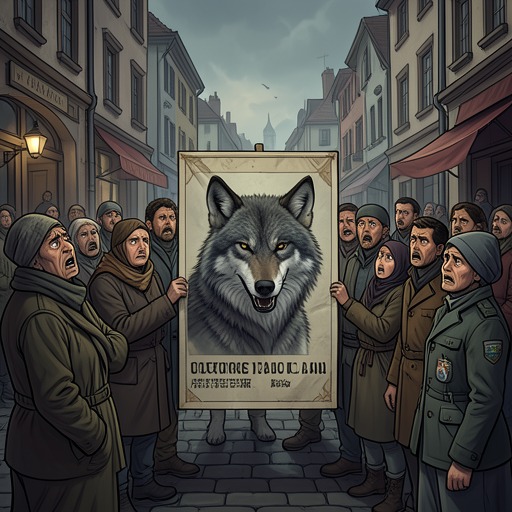
The panic began with one wolf, not the several packs that soon figured in the alarm. A Canadian Army corporal returning to barracks after visiting the Churchill beer hall said that a huge wolf had leapt at him and that he had escaped by running to the guardhouse. He produced no physical evidence, although the account notes that the experience had evidently affected him. His warning was enough to prompt a rapid military response: American and Canadian contingents mobilized, and armed squads searched the surrounding country with rifles, carbines, and spotlights. Within hours, the reported menace had multiplied in public imagination from one animal to several packs.
The consequences of that alarm were real even though the imagined invasion was not. During the ensuing excitement, eleven Husky dogs, an American serviceman, and an Indigenous man returning home late became casualties of the vigilantes. For two days, women and children stayed indoors; soldiers largely disappeared from the camp on foot, and men who had to travel to distant buildings went armed by jeep or stayed away. Fear had become a practical system of confinement and armed movement, sustained by a danger that had not been verified.
The search produced a telling false identification. On the second day, an aircraft spotted an animal and a detachment of the Royal Canadian Mounted Police went out to deal with it. The supposed wolf was a cocker spaniel belonging to the Hudson’s Bay Company manager. The panic eased only on the third day, when a truck driver returning from the airport found a sick wolf lying on the road. It was too ill to move and was killed when the truck could not stop in time. The lone, incapacitated animal at the end of the episode bore little resemblance to the packs described during the hunt.
How an Incident Becomes a Legend
The episode did not end when the panic subsided. Residents of Churchill, and soldiers who had dispersed across the continent, continued to recount a wolf invasion. In later versions, the story acquired desperate encounters, attacks on women and children, torn-apart dog teams, and a whole community under siege. The book presents this accretion as the work of memory and retelling: a single sick wolf and a mistaken sighting become a collective catastrophe. The escalating story is striking not only because its details exceed the reported events, but because it preserves the panic as though the panic itself proved the threat.
That process reflects the broader pattern the book identifies in human reactions to rabid animals. Because the disease is seldom recognized, people may interpret erratic behavior as evidence of a wolf’s natural character. An incident involving a sick animal then appears to confirm a pre-existing belief that wolves are vicious and dangerous. The confusion between illness and intention turns an exceptional circumstance into a general accusation, while the stories that follow help keep the accusation alive.
What Hunting and Feeding Show
The book places these fearful claims beside observations of how Wolves pursue Caribou. The narrator’s early understanding had allowed for the familiar idea that wolves could catch almost anything and killed under the sway of an endless appetite for blood. Ootek offered a different account: Caribou fed the wolf, but the wolf helped keep the herd strong. He also stressed that after a kill, the wolves did not resume hunting until their food was gone and hunger required them to do so.
Observed hunts likewise appear selective rather than indiscriminate. Wolves might move at an unhurried pace through dispersed deer, occasionally making a short test run at one. If the Caribou ran well and appeared in good condition, the hunters stopped rather than continuing the pursuit. Prime bucks in peak condition were seldom tested; the wolves could not reasonably expect to catch them. These observations make success and failure, as well as the condition of the prey, central to the hunt—details omitted by the image of a predator that simply kills whatever it encounters.
The account also challenges the claim that wolves kill for sport or take more than they can use. Catching a large animal can require a long hunt and many miles of travel. Once a wolf has enough meat for itself and its family, the account describes it as resting, socializing, or playing rather than continuing to kill. A carcass may be revisited until little remains; when scavengers threaten the food, wolves may carry away and bury portions for later. The narrator examined sixty-seven Caribou killed by wolves after the animals had finished feeding. Most had been used so thoroughly that what remained was largely bones and other remnants; some long bones had been opened for marrow. The condition of many remains also suggested that the prey had been old, diseased, or seriously weakened. Together, these observations recast predation as difficult work, closely tied to need and prey condition.
Human Violence and the Use of Accusation
The myth is not sustained by fear alone. The book describes aerial hunting in which pilots pursued wolves over open ground or lake ice, sometimes driving them to collapse before they were shot. In one hunt, a wolf leapt at the ski of an aircraft flown low during pursuit. The crash killed the animal and the two men aboard. A sportsman’s magazine presented the incident as proof of the wolf’s cunning and danger and praised the men’s courage. The reversal is central to the account: an episode arising from a human pursuit was retold as evidence against the pursued animal.
The book identifies this justification as a recurring feature of campaigns to destroy animals. Those who kill may attribute vicious or revolting qualities to the creatures they target; in the account’s formulation, the weaker the reason for slaughter, the more intense the vilification. The Churchill panic demonstrates how quickly fear can distort an event, while the hunting anecdote shows how violence can be reframed after the fact. Against both, the observations of sick animals, selective hunts, and careful use of food offer a more particular picture than the myth allows. The wolf’s reputation emerges not simply from what wolves do, but from the stories people construct around their fear and their own actions.